You may also like
Bone China Mugs 380ml/13oz-THU608
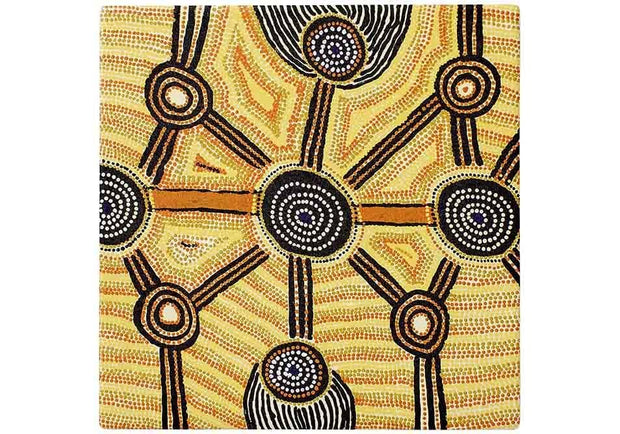
Pikilyi is an important natural spring and water-hole at Mt Doreen Station in the Northern Territory. Pikilyi is the home of two rainbow serpents, a married couple. The wife was a Napananka skin group and the husband a Japangardi, a taboo relationship in the Walpri culture. The serpents are the “kirda’ traditional owners of that country.
Bone China Mugs 380ml/13oz-DYM975
This is a very detailed painting which describes a dry time of year in Damien's homeland, Mount Liebig. The painting illustrates aspects of landscape and culture around that area that was told to Damien by his great-grandmother and great- grandfather. There are women sitting with their children collecting bush potatoes (the mass of red shapes at the bottom of the painting). The women are talking and getting ready for a ceremony. There is one man (wati) sitting down with his waru (spear). The spinifex is dry and so the man is walking around making bushfires. He is a good man, he is undertaking controlled burnings so the spinifex burns up and then good fruits can grow after this. There are several symbols in this painting. The small sun-like symbols represent women's body painting these are the images the women are painting on each other as they sit down ready for inma traditional ceremony. There is a dry creek bed running through the painting (in red and white), and there are cracks in the ground and claypans. There are also dried rockholes (tjukula), and next to them are tali sandhills.
Bone China Mugs 380ml/13oz-JTI151
This painting is about the story of the Rainbow Serpent, a dreaming story that is common to so many Aboriginal cultures. Each region has it’s own part of the story to tell. This painting is also about the artists’ dance that tells the story.
380ml/13oz-JWA677
MINA MINA JUKURRPA
The country associated with this Jukurrpa is Mina Mina, a place far to the west of Yuendumu, which is significant to Napangardi/Napanangka women and Japangardi/Japanangka men. All of them are the custodians of the Jukurrpa that created the area.
The Jukurrpa story tells of the journey of a group of women of all ages who travelled east, gathering food, collecting Ngalyipi (snake vine – Tinospora smilacina), and performing ceremonies as they travelled. The women began their journey at Mina Mina, where karlangu (digging sticks) emerged from the ground. Taking these implements, the women travelled east, creating Janyinki and other sites. Their journey took them far to the east, beyond the boundaries of Warlpiri country.
The Ngalyipi vine grows up the trunks and limbs of the Kurrkara (desert oak – Allocasuarina decaisneana) trees. Ngalyipi is a sacred vine to Napangardi and Napanangka women and has many uses. It can be used as a ceremonial wrap, as a strap to carry parrajas (wooden bowls) that are laden with bush tucker, and as a tourniquet for headaches.
The wavy lines represent the snake vine, the ‘u’ shapes represent the women, the circular shapes are edible mushrooms the women collect on their travels, and the two straight lines in the middle represent digging sticks.