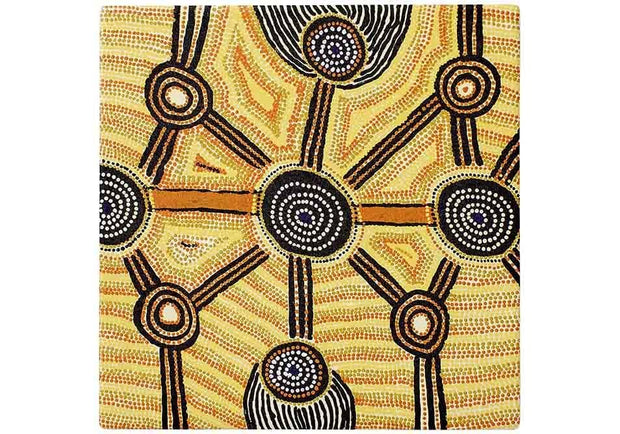
Ceramic Trivet By Ikuntji Artists Featuring Kalaya Tjukurrpa By Sam Tjapanangka George
Regular price
$15.00
14 in stock
The Ikuntji collection designed by Ikuntji Artists is characterised by their signature bold colour choices and decisive brush strokes. Ikuntji artists are proudly a member of the Indigenous Art Code, authentically supporting Indigenous artists.
Aboriginal Bush Traders
Stephen Nelson Powder Coated Bowl Large from Better World Arts
Regular price
$30.00
1 in stock
Diameter: 20.5cm
Height: 10cm
POWDER COATED BOWL LARGE-SJN699
Janganpa Jukurrpa (common brush-tail possum [Trichosurus vulpecula] Dreaming) travels all over Warlpiri country. Janganpa are nocturnal animals that often nest in the hollows of white gum trees (wapunungka). This story comes from a big hill called Mawurrji, west of Yuendumu and north of Pikilyi (Vaughan Springs). A group of janganpa ancestors resided there. Every night they would go out in search of food. Their hunting trips took them to Wirlki and Wanapirdi, where they found pamapardu (flying ants). They journeyed on to Ngarlkirdipini looking for water. A Nampijinpa women was living at Mawurrji with her two daughters. She gave her daughters in marriage to a Jupurrurla janganpa but later decided to run away with them. The Jupurrurla angrily pursued the woman. He tracked them to Mawurrji where he killed them with a stone axe. Their bodies are now rocks at this place. Warlpiri people perform a young men's initiation ceremony, which involves the Janganpa Jukurrpa. The Janganpa Jukurrpa belongs to Jakamarra/Jupurrurla men and Nakamarra/Napurrurla women. In Warlpiri paintings traditional iconography is used to represent this Jukurrpa. Janganpa tracks are often represented as E shaped figures and concentric circles are used to depict the trees in which the janganpa live, and also the sites at Mawurrji.